
Key takeaways
1) As the threats facing kelp forests are diverse, so are the methods for conserving, protecting, and managing these ecosystems. There is no universal approach, and conservation must be adapted to the local context.
2) Monitoring is the most common type of kelp conservation used across regions.
3) Communities are increasingly involved in kelp conservation projects.
4) Indigenous stewardship, based on deep connections to local kelp forests, provides a complementary model for kelp conservation.
3.2 Conservation actions in kelp forests
Marine protected areas (MPAs) can reduce direct pressures such as fishing, harvesting, and habitat disturbance. They are most effective when they are well designed, enforced, and aligned with the main local stressors, and protected in accordance with international standards such as IUCN or ProtectedSeas. MPAs can support kelp resilience, but they cannot directly prevent impacts such as marine heatwaves or land-based pollution.
Harvest management regulates the removal of kelp through tools such as quotas, seasonal closures, size limits, licensing, and spatial restrictions. Its role is to keep extraction within sustainable limits and avoid disrupting the ecological relationships that maintain healthy kelp forests. Regulation is only relevant in areas with active kelp harvest (see Figure 2.2).
Monitoring tracks changes in kelp extent, condition, biodiversity, and key stressors over time. It provides the evidence needed to detect decline, assess whether management is working, and adapt interventions as conditions change.
Community-led efforts involve local communities, Indigenous peoples, fishers, and other coastal groups in stewardship, monitoring, restoration, and decision-making. These approaches can strengthen legitimacy, draw on local knowledge, and improve the long-term continuity of conservation action.
Policy reform and design create the legal, institutional, and financial conditions needed for sustained management. This can include recognising kelp forests in biodiversity plans, setting protection or restoration targets, improving permitting, coordinating agencies, and establishing long-term funding mechanisms.
Restoration: see Chapter 5.
3.3 What is happening now
Ecosystem monitoring is the most common form of kelp forest conservation and management. Eighty-six per cent of regions reported long-term monitoring programmes (e.g., Reef Check, PISCO, and Reef Life Survey). Communities were also heavily involved in kelp forest conservation with 63% of regions reporting community-led or community-linked conservation efforts. Policy planning and marine protected area planning specific to kelp forests are less common but still reported in approximately 50% of regions. The least common method for kelp conservation is harvest management (43%), though only a limited number of countries (e.g., Japan, Korea, France, Norway, Australia, and Chile) have active harvest industries to manage.

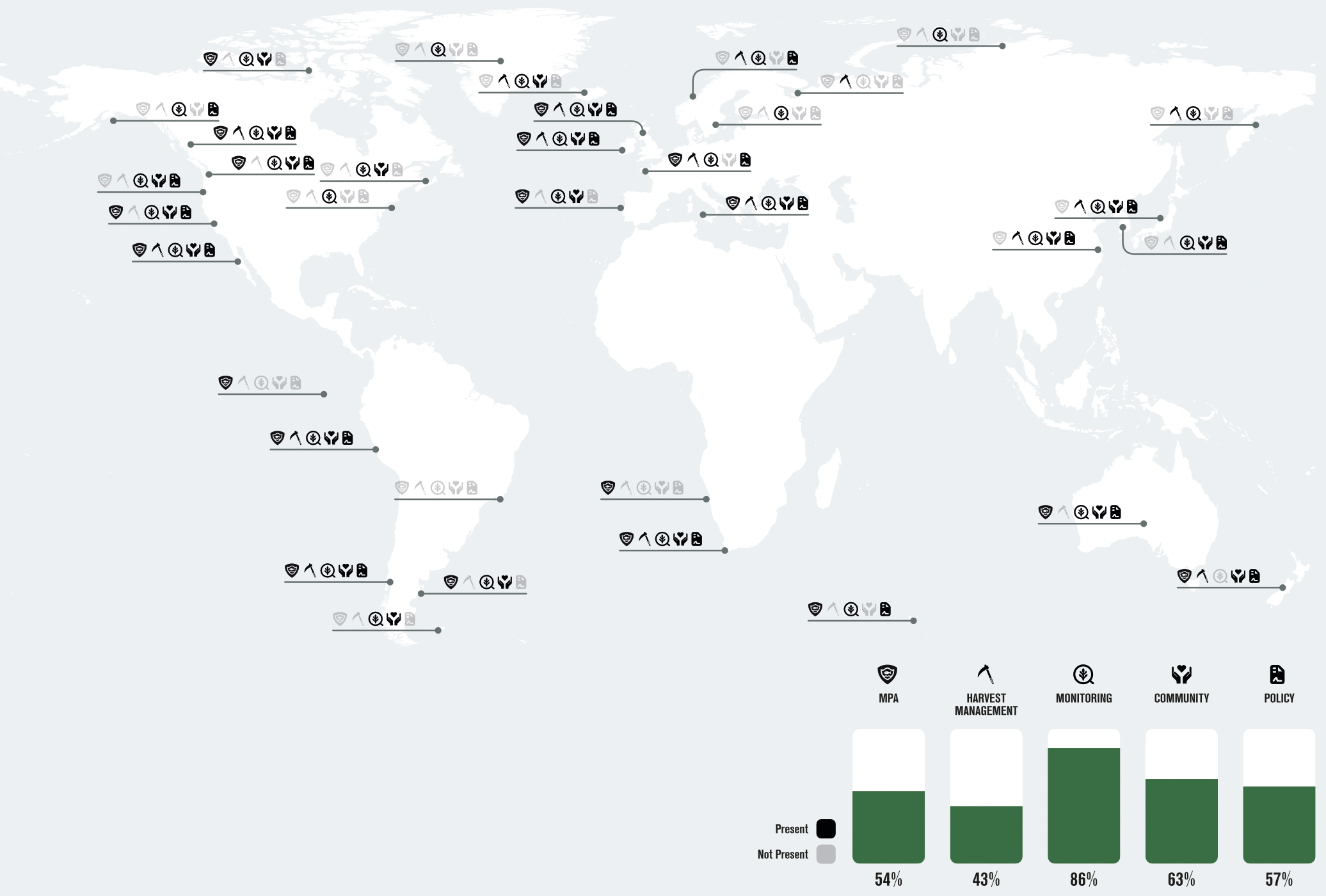
Figure 3.1. Conservation actions reported across kelp forest regions. The map shows the actions reported in each region; the bars summarise the percentage of regions reporting each action.1
3.4 Conservation gaps
Not all kelp forests need management interventions, and not all kelp systems that need conservation receive the needed response. Our expert survey revealed areas where the capacity to respond outpaced the need (green zones, 10/31, e.g., Ireland, Argentina, and the Arctic), areas where the response was roughly proportional to the need (yellow zones, 13/31, e.g., California, Australia, and Japan), and areas where the stressor was greater than the response (pink zones, 8/31, e.g., the east coast of the USA, Peru, and the Mediterranean).
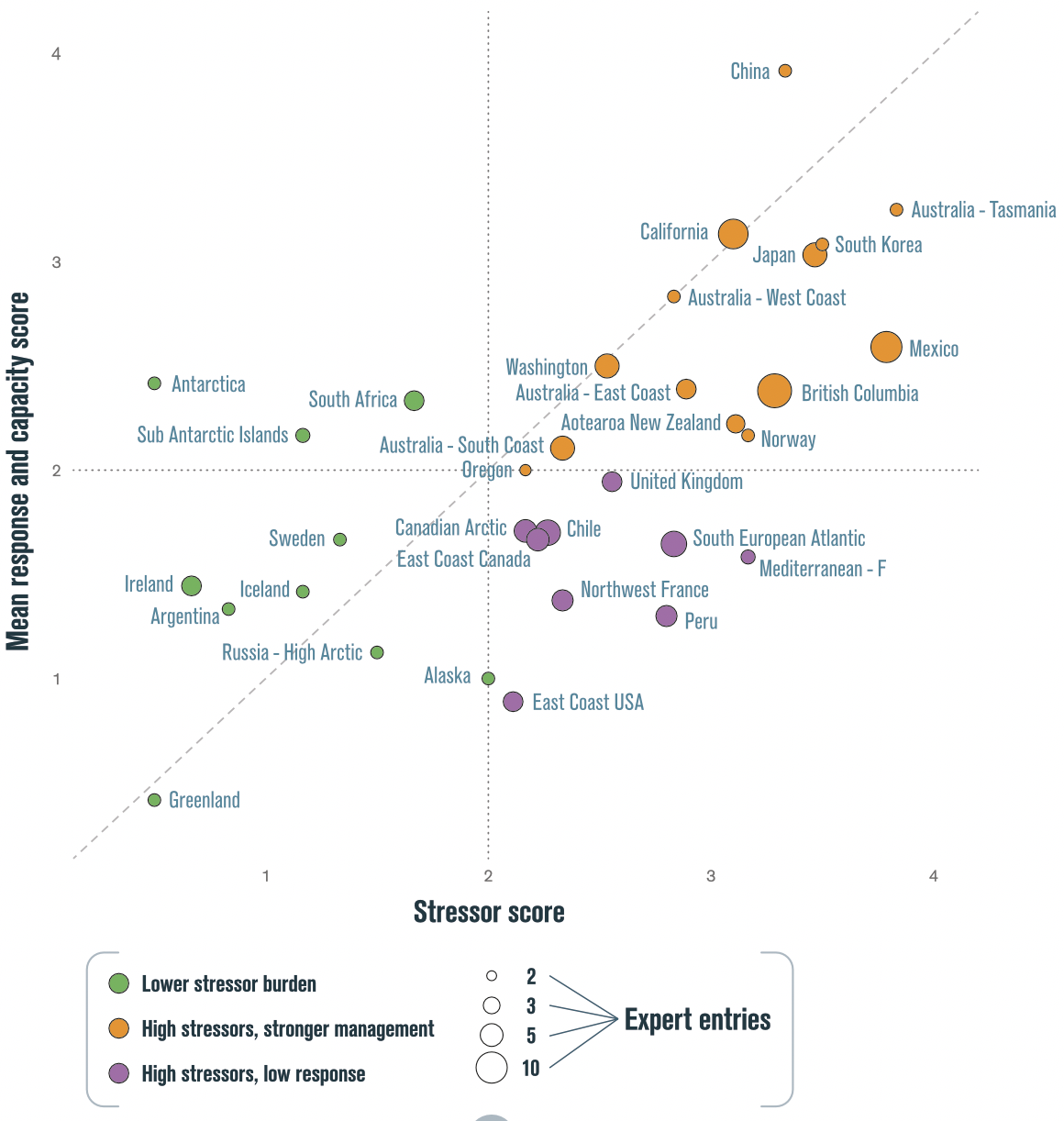
Figure 3.2. Stressor burden and conservation response across kelp forest regions. The scatterplot compares stressor scores with response and capacity scores. See Section 9.1 for the survey methods.
3.5 Indigenous stewardship of kelp forests
Authors: Makena Rush, Alejandra Paola González Vásquez, Loyiso Dunga, Betsy Peabody, Julianna Sullivan, Kelly Ferrier, Lineekela Kandjengo, Lynn C. Lee, Mairead Norton, Gwiisihlgaa Daniel McNeill, Marsha Mills, Mitchell Gibbs, Natalio Godoy, Shelley Estes, Tristin McHugh, Veronica C. Mills, Angelo Villagomez, Adriana Vergés, Aaron Eger
Across our world’s oceans, many Indigenous communities hold invaluable reciprocal relationships with kelp forests: long-standing connections rooted in stewardship, culture, and sustenance that span millennia. Many Indigenous communities continue to maintain intricate and dynamic relationships with kelp forests through harvesting their traditional foods, practising stewardship, transmitting knowledge across generations, crafting, sharing stories, and taking care of these ecosystems to sustain their ancestral connections to their lands and waters in daily life. These relationships persist despite the systemic impacts of settler colonialism and Indigenous dispossession.2 When a foundational species such as kelp faces decline, it can lead to well-documented ecological loss and less-recognised cultural, social, and economic loss.3,4 This issue is compounded by historical and ongoing marginalisation and exclusion from conservation decision-making processes.5 Indigenous relationships with and access to kelp forests can play a major role in addressing kelp decline, yet Indigenous peoples in many regions of the world are not given the support that is needed to lead in efforts to address this challenge. Ecological stewardship, restoration, and conservation can be profoundly transformed when Indigenous worldviews, governance, and knowledge systems are recognised, respected, and uplifted.3
In recognition of the indelible relationships that Indigenous communities have had with kelp forests for centuries across the globe, we have established the Indigenous Kelp Forest Stewards Community. Our members include Indigenous stewards and their allies from eight countries around the world. Our overarching goal is to raise the voices of Indigenous communities in their efforts to steward kelp forests, which is more important now than ever in the face of increasing human impacts and a changing global climate. We aim to build solidarity and capacity locally and globally by developing a worldwide network of communications and collaborations. Our membership currently spans the eastern Pacific, Aotearoa New Zealand, Australia, southern Africa, Atlantic Canada, South America, and other kelp-bearing coastlines.
Together, we acknowledge three key principles:
- Celebrating Reciprocal Relationships: Kelp forests are taken care of and restored by people who carry relationships, responsibilities, memories, skills, stories, and obligations to place. In turn, kelp forests can take care of those who depend on them.
- Recognising the Hidden Costs of Stewardship: Many of the people caring for kelp forests are doing this work with limited support while navigating ecological loss, institutional barriers, cultural and intellectual property risks, and the burden of explaining why their knowledge matters.
- Thriving People, Thriving Kelp Forests: Supporting kelp forests requires supporting the people who care for them, collaborating with respect and an open heart.

These principles guide our work as we seek to elevate Indigenous voices and leadership and co-create resilient spaces for intergenerational collaboration across geographies. Our work informs kelp forest stewardship, research, practice, and policy by offering place-based understandings of the interconnected ecological and human dimensions of kelp forest well-being. Through in-person workshops, storytelling, arts-based participatory engagement, and co-production of community resources, this network supports biocultural conservation and creates important opportunities for future partnerships. We seek to create a vital stepping stone and a holistic model towards achieving reparative environmental justice and equity in kelp forest stewardship.

Indigenous Voices in Kelp Forest Stewardship
The concept of Two-Eyed Seeing (Etuaptmumk, in Mi'kmaq), in its many forms, guides our work through the transformative embrace of Indigenous Knowledge and Western knowledge equally for the benefit of all.6 Community members lead with relational accountability: conducting stewardship and collaboration with respect, reciprocity, and ongoing responsibility. This approach holds individuals responsible for their actions based on their mutual relationships with people, communities, and environments.7