
Chapter at a glance
Technology has an important role to play in making kelp forest conservation more effective and more efficient. While the field has received little dedicated research and development compared to terrestrial and coral systems, we are seeing the emergence of innovative approaches and creative applications of technologies developed for other settings to improve kelp forest health. Here we highlight some emerging and established technologies that will help drive the future of kelp forest conservation.
6.1 Using underwater robotics and AI to monitor kelp forests
Arie J. P. Spyksma, Kelsey I. Miller, Shahrokh Heidari, Kelham Rawlinson, Katerina Taškova
Kelp forest management requires large-scale monitoring that is robust and up to date. Without it, we won’t be able to understand how kelp forests are changing or how well restoration or protection interventions are working. Currently, collecting these data is limited by the slow, expensive, and spatially limited nature of traditional marine monitoring methods and data analysis techniques. Future kelp forest management will therefore rely more heavily on technologies that enhance spatial coverage, increase automation, and reduce costs.
This problem is particularly pronounced for subsurface kelp forests, which require in-water data collection methods. Traditional methods are often costly, and slow, and require intensive diver time and data processing. Innovations in underwater image collection and automated robotics are, however, helping to solve this problem. By generating cost-effective, large-scale, georeferenced image datasets, autonomous and non-autonomous camera systems are beginning to significantly reduce the burden on divers. However, classifying these images manually requires many hours of work and delays the sharing and use of information, effectively limiting their full potential. Recent advances in machine learning (ML) capabilities are providing key opportunities to automate underwater image analysis, reducing bottlenecks and making better use of these large-scale datasets.1
AI image-processing tools are 24 times faster than manual processing
We use two of these new tools, Urchinbot and Habibot, to detect sea urchins2 and kelp habitat3 in northeastern Aotearoa New Zealand and southeastern Australia. AI image-processing tools are 24 times faster than manual processing and enable rapid, accurate detection of kelp loss and sea urchin abundance. Importantly, they also provide measures of detection confidence and can incorporate human verification where desired.
It is important to note that underwater imagery relies on visual information that can be obscured by low image resolution, poor water clarity, uneven lighting, and motion blur.4 Future technological advances and integration with other sensor types can help reduce but never entirely eliminate these issues. Collectively, these tools and others like them hold considerable promise for future conservation efforts, but communication and standardisation across workflows and platforms will be important to maximise their benefits. These approaches will therefore likely be a useful component of the kelp forest monitoring toolbox but not a complete substitute for traditional methods.
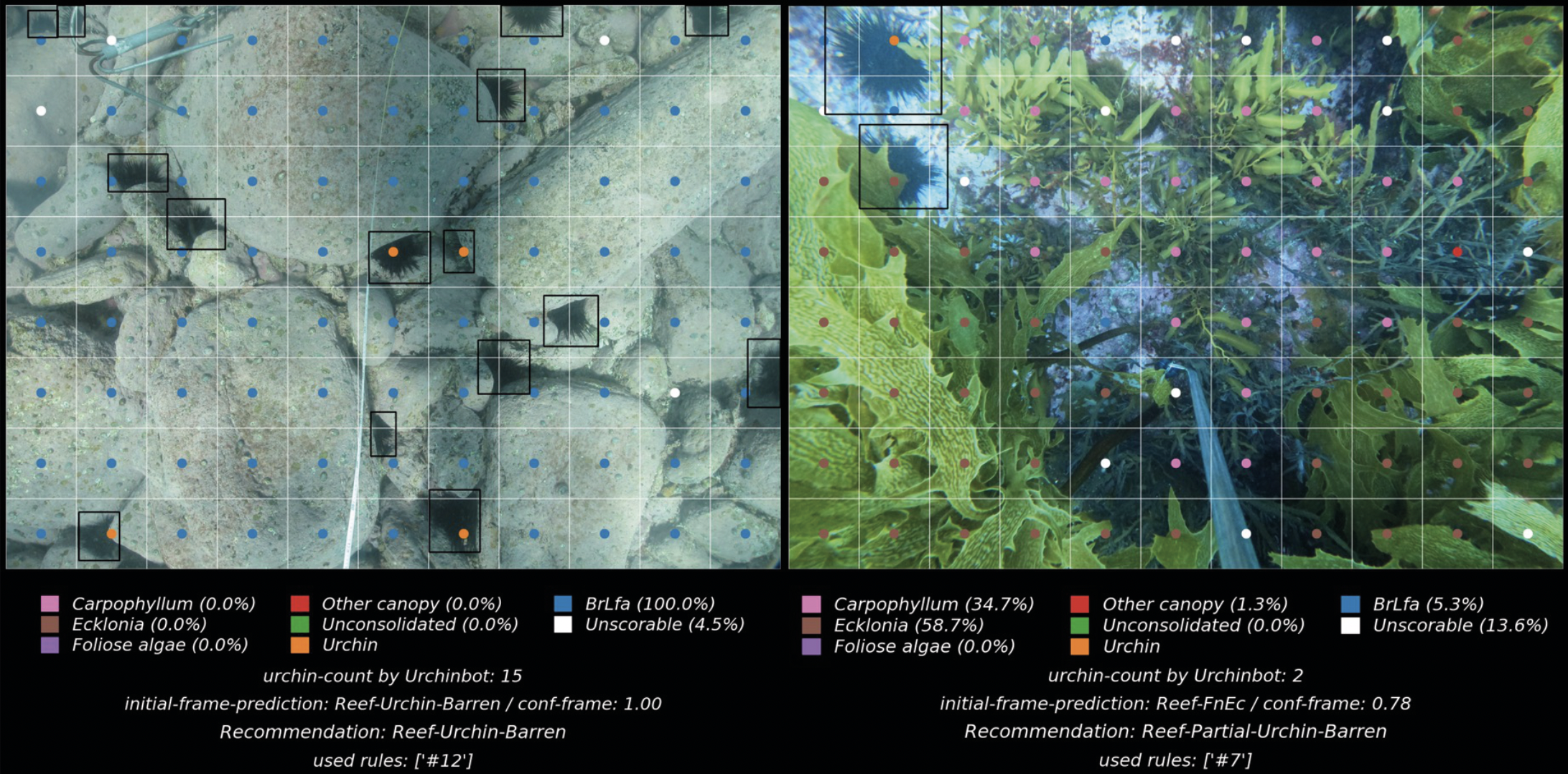
Figure 6.1. Urchinbot and Habibot AI toolkit in action. Together, these tools can rapidly identify urchin species (black boxes), provide patch-level habitat classifications (coloured points) and provide a whole-frame habitat prediction from images sourced from a range of camera platforms used across northeastern New Zealand and southeastern Australia.
6.2 Genetic preservation of kelp through cryo- and biobanking
Cintia Iha, Wouter Visch, Anusuya Willis
As kelp forest populations and their genetic diversity are being lost, biobanks play a key role in supporting kelp conservation. These facilities allow the long-term storage of the genetic material needed to conserve kelp populations for years. Importantly, kelp biobanks can preserve a wide variety of strains, safeguard genetic resources, support selective breeding, and provide a reliable, readily available source of kelp tissue for research, cultivation, and restoration.
To establish a valuable biobank, it is essential that the strains are strategically collected across their geographic range and genetically characterised to assess levels of diversity and differentiation among populations. This information is fundamental for designing safe and successful restoration programmes. Genetic screening can also detect markers associated with adaptive traits, such as heat tolerance, providing valuable information for conservation.
Kelp biobanking uses two approaches: maintaining living cultures and cryopreservation.
Living gametophyte cultures: Laminarian kelps have two stages in their life cycle, including a microscopic gametophyte. These gametophytes provide a continuous source of reproductive material that can be maintained for many years under stable laboratory conditions (low temperature, stable nutrients, and red light). Maintaining living gametophyte cultures successfully requires dedicated facilities and regular maintenance, as cultures decline in quality when maintained for many years. As a result, adequate infrastructure and skilled technicians are needed to sustain biobanks and their benefits over the long term.
Cryopreservation: A complementary approach to living kelp biobanking is cryopreservation, which enables the long-term storage of kelp genetic resources at ultra-low temperatures (typically in liquid nitrogen at -196 °C). Kelp gametophytes are particularly suitable for cryobanking because they can be recovered and cultured after thawing, eliminating the need for continuous maintenance and reducing risks associated with contamination, genetic drift, or equipment failure. While such longevity is beneficial, substantial resources are needed to maintain these biobanks indefinitely.
Cryobanking is now also being developed for fucoid kelps, which lack a gametophyte life-history stage. For these species, cryobanking instead relies on preserving gametes or germlings.5 Advances in biobanking, genomic sequencing, and cryopreservation are expected to transform kelp conservation from simple strain preservation to strategic management of adaptive genetic diversity. Future biobanks will likely integrate genomic information with cryobanked collections, enabling the identification, preservation, and use of populations with desirable traits and enhanced restoration potential.
Nationally and internationally coordinated kelp biobanking networks could provide a global safeguard against biodiversity loss while supporting conservation and restoration.
Kelp cryobanking and biobanks are essential to safeguarding the future of kelp forests. Effective biobanks require strategically collected samples and genetic and physiological characterisation to establish a beneficial, viable, and fit-for-purpose collection.
6.3 Genetic selection and manipulation in kelp species
Brandon Vong, Kelly DeWeese, Jaycee Lanza, Sergey Nuzhdin
Genetic tools are opening new possibilities for how kelp forests might be restored and managed in a changing ocean. Kelp researchers now have access to reference genomes6 and increasingly detailed information about the genes associated with growth, reproduction, and environmental tolerance. However, the practical tools needed to deliberately alter kelp genetics are still at an early stage.
In the near term, the most likely application is selective breeding informed by genomics. Researchers can identify naturally occurring genetic variation associated with desirable traits, such as faster growth or greater tolerance to heat, and use this information to guide which individuals are crossed.7 Because this approach works with genetic variation already present within kelp populations, it does not require direct modification of DNA.
More targeted approaches, including CRISPR-based gene editing, could eventually allow researchers to alter specific traits directly. Proof-of-concept genetic engineering tools have been demonstrated in kelps, but practical applications remain limited.8 Potential uses include improving thermal tolerance, increasing productivity, or developing sterile or sporeless cultivars that could reduce the risk of genes spreading into wild populations.9
These technologies may become increasingly relevant as restoration confronts climate change. Restoring a kelp population to the conditions in which it historically existed will not be enough if those conditions are rapidly changing. Selective breeding, assisted adaptation, and, potentially, gene editing could help produce kelp better able to survive future temperatures and other environmental pressures.7,10
However, greater ability to modify kelp also brings greater responsibility. Introducing genetically modified kelp into the ocean raises questions about gene flow, ecological interactions, reversibility, and appropriate scales of use. Robust monitoring and clear safeguards would be needed before such approaches could move from experimental systems into open ecosystems.
The key question is therefore not simply whether kelp can be genetically modified, but when and where genetic intervention might be justified. Researchers, restoration practitioners, Indigenous peoples, communities, regulators and policymakers will need to determine acceptable uses and risks together. Genetics could become an important part of the restoration toolbox, but its role should be guided by clear conservation goals, ecological evidence, and appropriate governance.
6.4 Kelpwatch: mapping kelp by satellite
Tom Bell
Kelp forests form incredible, structurally complex, and rich ecosystems. And while these forests are extensive, they are also dynamic. Species like bull kelp (Nereocystis luetkeana) can form dense canopies within a single season, and those canopies can disappear even faster after a disturbance. Observations have typically lagged behind this rapid pace of change, as field surveys generate precise data but cover limited areas and are collected intermittently. As a result, managers are routinely asked to detect and respond to ecosystem changes months or years after the changes have occurred.
Kelpwatch (www.kelpwatch.org) addresses these issues for kelp forests that form visible surface canopies. Created in partnership with The Nature Conservancy, the Woods Hole Oceanographic Institution, UCLA, and UC Santa Barbara, the platform processes over four decades of Landsat imagery into open-access, seasonal data on emergent kelp canopy that can be freely visualised, queried, and downloaded. Importantly, the data are relevant at multiple scales, from a single bay to continental coastlines. Coverage has expanded from the west coast of North America to Alaska, Peru, Argentina, the Falkland Islands, South Africa, and Namibia.
These data are a valuable tool for resource management. The California Department of Fish and Wildlife incorporated the canopy record into its Enhanced Status Report for giant kelp and bull kelp and has used it to screen candidate restoration sites. More broadly, the satellite archive provides the historical baselines upon which conservation decisions depend. Declines in kelp canopy are difficult to interpret without knowledge of prior conditions, and for most of the world's coastline, no field survey records exist.
For most of the world's coastline, no field survey records exist.
While these near real-time canopy data are useful, important limitations remain. For example, subsurface and understorey kelps are not visible, and canopy area alone provides no information on associated animals or whether the kelp is reproductively healthy. The current resolution misses narrow fringing beds, and cloud cover can obscure observations when and where they are most needed. Satellite monitoring therefore complements, rather than replaces, field surveys, which remain essential for science and management.
Newer satellite systems such as Sentinel-2 and commercial constellations (e.g., Planet) will improve spatial and temporal resolution. Hyperspectral sensors such as NASA's EMIT and planned missions such as NASA's EAGLE programme and ESA's CHIME offer the potential to detect species composition and habitat condition in addition to canopy cover.
6.5 Selective breeding for climate-resilient kelp forest restoration
Cecilia Biancacci, Cawthron Institute
As ocean conditions continue to change, there is hope that selective kelp breeding can help restored populations adapt to new environmental conditions. Selective breeding has substantially improved the cultivation of kelp, particularly in Asia, where controlled crossing and selection have enhanced production traits.11 However, its application to kelp forest restoration remains experimental. Current initiatives focus on identifying naturally resilient individuals, crossing genotypes, or propagating selected material, while long-term, multi-generation breeding programmes have yet to be established.12
Restoration objectives are more complex than producing kelp that survives transplantation. They aim to establish genetically diverse, self-sustaining populations that reproduce, recruit new generations, and persist under future conditions. Achieving this will depend on using natural variation within kelp populations to identify traits that support long-term resilience, including thermal tolerance, growth, reproductive performance, and disease resistance.11,12
In the wild, we hope to find natural genetic variations that are beneficial for new populations. Experimental studies have identified kelp family lines with enhanced tolerance to warming, but this tolerance is not reliably predicted by temperatures in their native habitat.13 Evidence for local adaptation varies with genetic background, environment, and ecological pressures.14 As a result, we need further research to understand what reliably predicts adaptability or tolerance in kelp forests.
Experimental studies have identified kelp family lines with enhanced tolerance to warming, but this tolerance is not reliably predicted by temperatures in their native habitat.
Once we do find a desirable population, we must still make sure that tolerance can be validated across multiple sites, environments, and generations. We should not measure success only by early survival and growth, but also by how that kelp functions in its natural environment (reproduction, natural recruitment, genetic diversity, and the recovery of broader ecosystem functions).12,14
While selective breeding could provide real benefits, we must exercise significant caution as well. Even one generation of nursery propagation can reduce genetic diversity, increase inbreeding, and favour traits suited to artificial conditions rather than the wild.15 Responsible implementation will require genetically diverse broodstock, replicated field trials, long-term monitoring, strong biosecurity, and clear governance. As we are altering the genetic composition of our ocean ecosystems, any decision-making must involve Indigenous peoples, local communities, scientists, and stakeholders.12,16
By increasing survival, reproductive success and long-term persistence, selective breeding could become a valuable tool for improving restoration outcomes as ocean warming intensifies. However, it should complement rather than replace efforts to protect existing kelp forests, restore habitats, and address the underlying drivers of decline.12,16
6.6 Rewilding marine food webs with predator reintroductions
Marianne Frantzen, Casey Benkwitt, Jono Wilson
Rewilding is emerging as a promising approach to kelp forest restoration. Rather than restoring habitat alone, it seeks to rebuild the species interactions and ecological processes that help ecosystems regulate themselves.
This is particularly relevant where predator losses have contributed to sea urchin population increases and persistent barrens. Human-led urchin removal can trigger rapid kelp regrowth, but sustained recovery may remain difficult if the underlying food-web imbalance persists.
In northern Norway, declines in predatory fish contributed to an ecosystem shift in the 1970s, when extensive kelp forests were transformed into urchin barrens that persist in many areas today.17 The BlueRewilding project is testing whether rebuilding populations of Atlantic wolffish (Anarhichas lupus), a native sea urchin predator, could help maintain restored kelp forests. It is developing techniques for future pilot releases while testing whether predator recovery can reduce reliance on repeated grazer removal.
A parallel effort is underway on the west coast of North America. Predatory sunflower sea stars (Pycnopodia helianthoides) declined by more than 90% across much of their range following sea star wasting disease beginning in 2013.18 In northern California, their loss coincided with severe ocean warming events and contributed to expanding urchin populations and subsequent kelp declines. Modelling suggests sunflower sea star recovery could help control urchins and complement interventions such as urchin removal and kelp seeding.19,20 The Pycnopodia Recovery Working Group is coordinating efforts to advance disease research, captive rearing, and small-scale experimental reintroductions; see Roadmap to Recovery.21
Predator reintroduction also carries risks. Released animals may fail to survive or remain in target areas, and restored predators could affect non-target species. Ecological responses may also vary among locations, meaning predator restoration cannot be assumed to recreate historical food webs automatically.
For these reasons, the field is moving cautiously from predator recovery as a conservation goal towards predator recovery as an ecosystem-restoration tool. The next step is replicated trials that test survival, movement, predation, disease risk, and ecosystem responses alongside conventional kelp-restoration approaches.
As we seek to restore kelp forests, it is important that we consider not only how we restore associated biodiversity but how that biodiversity may enable restoration itself.