
9.1 Expert opinion survey
This assessment draws on a structured global survey of kelp forest experts, practitioners, and managers. Participants provided information only for regions where they had substantial knowledge or experience.
The survey assessed four aspects of kelp forest conservation: threats and stressors, current conservation action, capacity to respond, and ecosystem benefits. Sixteen indicators were scored using consistent criteria, allowing broad comparisons among regions.
Responses were combined to produce regional summaries and to identify places where conservation action and capacity may not be keeping pace with the pressures facing kelp forests.
The results represent expert-informed assessments rather than direct measurements of ecological condition or management effectiveness. The number of respondents and the availability of evidence varied among regions, so findings from areas with limited responses should be interpreted cautiously and alongside other available information.
9.2 Kelp protection analysis
We estimated how much of the global kelp biome overlaps with marine protected areas and how strong that protection is likely to be.
The kelp biome was represented using a global model of potential kelp distribution1, restricted to waters shallower than 60 metres. This captures the broad environmental range in which kelp forests may occur, but it is not a direct map of observed kelp. It may overestimate habitat because it does not account for the availability of rocky reef, while also underestimating kelp distribution in places that were inaccurately modelled.
We overlaid this biome layer with two complementary protected-area datasets. The World Database on Protected Areas was used to estimate the overall area of kelp habitat located within designated protected areas. ProtectedSeas’ Level of Fishing Protection dataset was used to assess the strength of fishing restrictions within those areas, with a focus on moderately and highly protected sites.
Where protected areas overlapped, each location was assigned to the highest applicable protection category to avoid double-counting. These results indicate the spatial extent and likely regulatory strength of protection, but they do not directly measure enforcement, management effectiveness, or ecological outcomes.
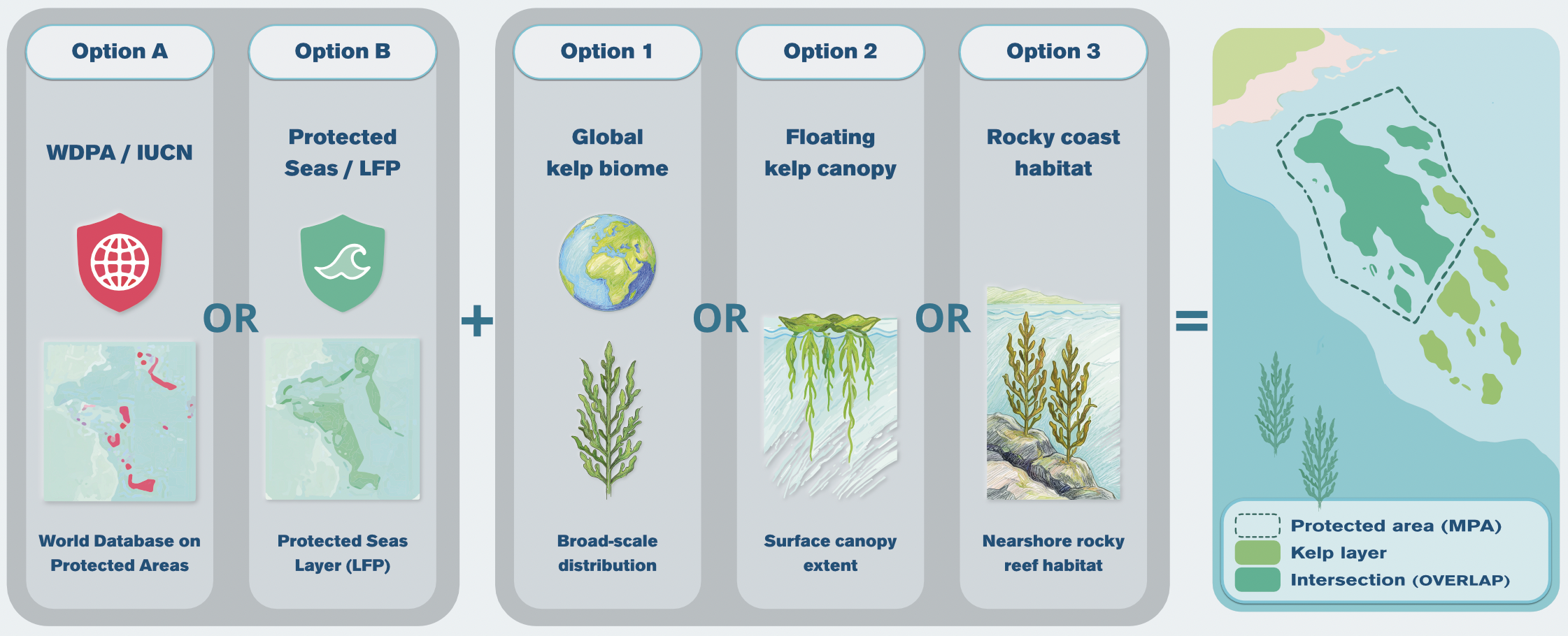
Figure 9.1 Overview of the kelp protection analysis. Habitat and protected-area layers are overlaid to estimate spatial overlap. See Section 9.2 for the habitat layer and protection datasets used in this report.