
Chapter at a glance
Restoration is expanding around the world, but progress remains uneven. A small number of larger programmes are showing that kelp forests can be restored at meaningful scales, while many projects remain small, experimental, or difficult to sustain and expand. Here, we highlight the main approaches being used and examine examples where restoration has succeeded at scale, focusing on the methods, partnerships, funding, and long-term management that have helped make recovery possible.
5.1 Where is restoration happening?
The state of restoration varies significantly among regions. Some regions have not lost any kelp forests (often at higher latitudes) and therefore require no restoration. When restoration is required, the methods depend on why the kelp forests have declined, what resources are available, and local attitudes towards restoration. The most common forms of restoration are kelp seeding (46% of regions), transplanting adults (31%), and sea urchin removal (29%). Substrate modification and future-proofing techniques are less common, with just 20% of regions reporting activity for either technique. Fifty-one percent of regions have no active restoration, though just six of those (Alaska, Peru, Galapagos, the eastern USA, eastern Canada, and Argentina) require restoration.

Figure 5.1. Restoration methods reported across kelp forest regions. The map shows regional activity, and the bars show the percentage of regions reporting each method or no active restoration.
5.2 How restoration happens
Active restoration may be needed when reducing threats, improving management, or protecting an area is not sufficient to return a kelp forest to a healthy, self-sustaining state. Before restoration begins, it is essential to understand why the kelp forest declined and whether those pressures are still operating. If the underlying causes, such as poor water quality, excessive grazing, unsuitable substrate, or repeated marine heatwaves, are not addressed, restored kelp may fail to establish or persist.
Kelp forest restoration generally uses four main approaches:
Seeding introduces kelp spores, microscopic life stages, or juvenile kelp to suitable habitat. Seeded material may be deployed on lines, gravel, tiles, or other attachment surfaces.
Transplanting moves juvenile or adult kelp from donor populations or cultivation facilities and attaches them directly to a restoration site.
Grazer control reduces or manages overabundant herbivores, particularly sea urchins, so that kelp can recover naturally or so seeded and transplanted kelp have a greater chance of survival.
Substrate enhancement adds, restores, or modifies suitable attachment surfaces where the existing seabed does not support kelp recruitment or establishment.
Future-proofing is an important consideration that can be incorporated into seeding and transplanting by accounting for the genetic diversity, origin, and environmental suitability of the kelp being introduced. This can include maintaining broad genetic diversity, selecting source populations suited to local conditions, and considering how restored populations may respond to future warming and other environmental change.
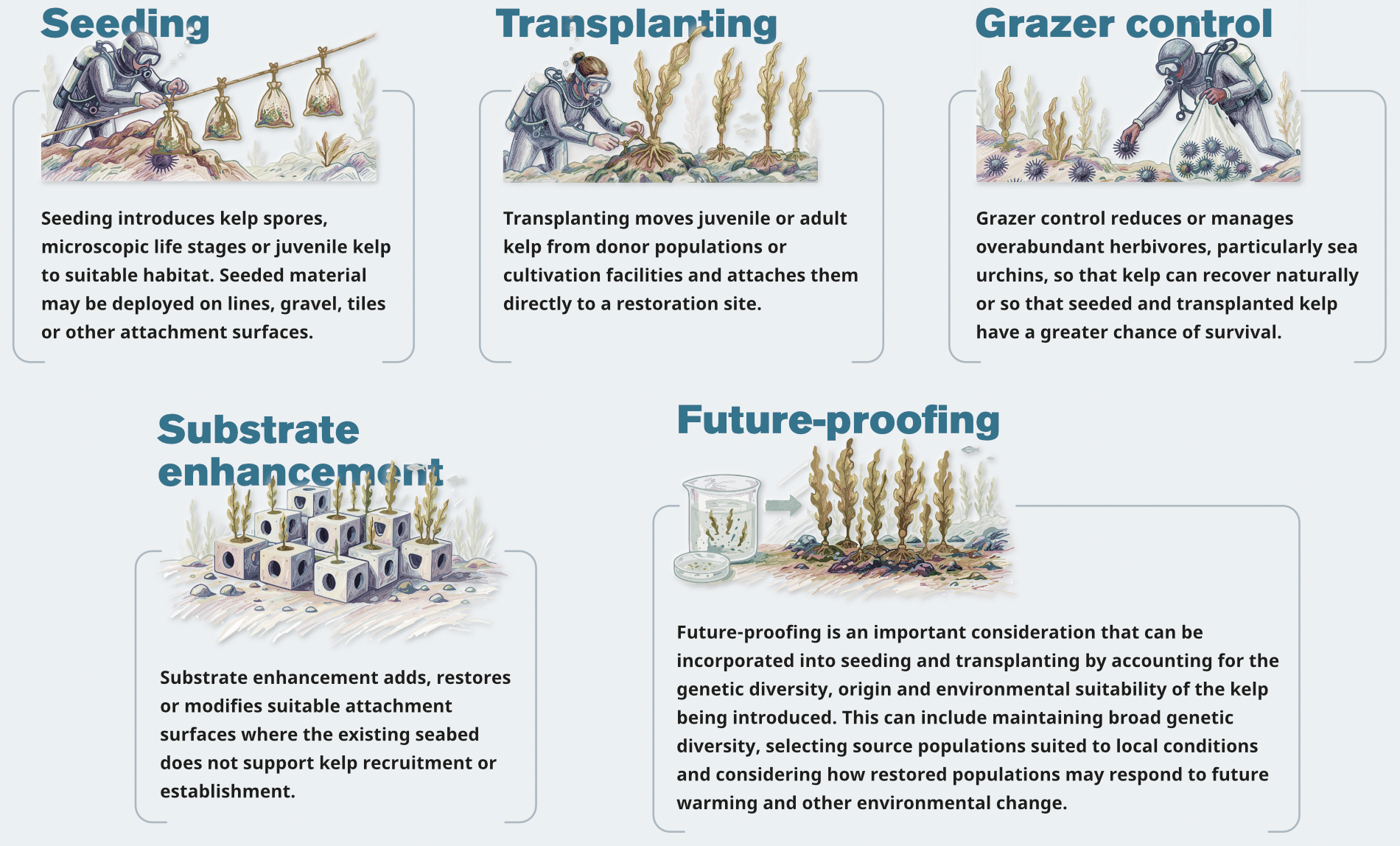
Figure 5.2. Approaches to kelp forest restoration: seeding, transplanting, grazer control, and substrate enhancement. Future-proofing can be incorporated into these approaches by considering genetic diversity and environmental suitability.
Restoration projects often combine several of these approaches. The most appropriate strategy depends on the cause of decline, the likelihood of natural recovery, local environmental conditions, the species being restored and the ecological, cultural, and social context of the site. Long-term monitoring is then needed to determine whether restored kelp survives, reproduces, and develops into a self-sustaining population.

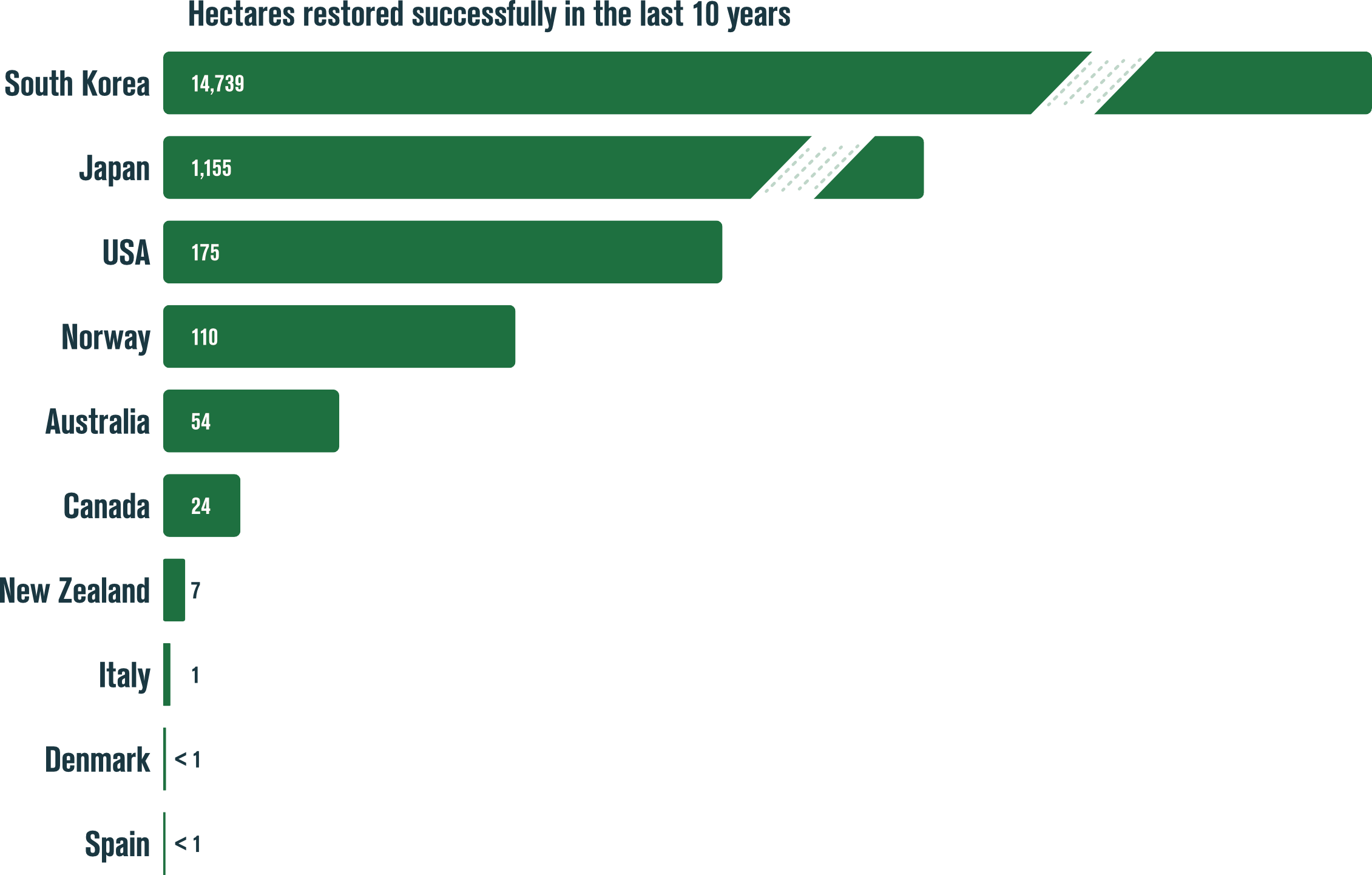
Figure 5.3: Cumulative area (hectares) of tracked kelp forest restoration globally since 1960.
5.3 Tracking global restoration activity
The Kelp Forest Alliance maintains a global database of kelp forest restoration projects. It allows registered users to upload the outcomes of their restoration projects and contribute to the global tally. As of publication, 285 projects had been uploaded from 15 countries, and these entries were used to generate the reported figures. While the database is inclusive of project types and countries of origin, it is currently only available in English, and this biases the results. The database has tracked 19,071 ha of successful kelp restoration (Figure 5.3). Progress is geographically skewed, with over three-quarters of that restoration occurring in South Korea. There may be more restored area in South Korea than is reported in the database (see Section 5.5).
5.4 Japan: Restoring kelp forests through fisheries, carbon finance and coastal partnerships
Tomohiro Kuwae
In Japan, kelp and other macroalgal forests are increasingly restored as working coastal systems that support fisheries, climate action, and regional economies. This reflects the country’s long coastline, its long history of seaweed use, and the dependence of many coastal communities on productive algal habitats. Where isoyake barren grounds have expanded, macroalgal loss has therefore become both an ecological problem and a threat to fisheries and livelihoods.
Two complementary policy mechanisms have helped make restoration more visible and attractive to investors. The voluntary J-Blue Credit scheme, administered by the Japan Blue Economy Association, certifies carbon dioxide removal generated through the creation, restoration, and management of marine vegetated ecosystems. By 2025, it had certified 61 projects and recorded 471 transactions; macroalgal beds represented 49.2% of projects and seaweed farming a further 18.0%. Japan also incorporated removals from seagrass meadows and macroalgal beds into its national greenhouse gas inventory in 2024. National accounting recognises macroalgal carbon removal in climate policy, while J-Blue Credit creates a pathway for private finance to support local action.1
49.2% of projects certified through Japan’s J-Blue Credit
scheme involved macroalgal beds.
The fisheries benefits are particularly evident in Shakotan, Hokkaido, where fishers have restored macroalgal beds since 2009 in response to expanding barren grounds and declining sea urchin production. The project combines urchin-density management, deployment of fertile adult algae, and the reuse of discarded sea urchin shells as restoration material. The restored habitat provides food for sea urchins, linking ecological recovery directly to harvest volume and product quality. The project estimated that restored beds could support about 390 kg of additional shucked sea urchin production, valued at approximately JPY 30.6 million, while also generating certified blue-carbon removals and supporting environmental education.2
These projects depend on partnerships. Across the J-Blue Credit portfolio, fishers, municipalities, companies, community groups, and academic institutions share responsibility for implementation, finance, monitoring, and long-term continuity.
Japan is also testing hybrid “green–grey” approaches, including steelmaking slag and other recycled or dredged materials as substrates for macroalgal-bed creation. In Hiroshima Bay, steel-slag substrates were used to establish Sargassum beds intended to support biodiversity and fishery recovery.3
The broader lesson is that restoration may be more durable when carbon is treated as one benefit among many. Fisheries, biodiversity, education, tourism, local identity, and infrastructure performance can be equally important to long-term success.
5.5 South Korea: Scaling kelp restoration into a national programme
Kyungsun Lee, Yejin Hyeon
South Korea has turned kelp restoration from a collection of local projects into a coordinated national programme. Seaweed barrens were first reported around Jeju Island and the southern coast in the 1980s and later spread to the East Sea. By 2025, a national aerial survey by the Korea Fisheries Resources Agency (FIRA) estimated that 34% of surveyed rocky seabed showed signs of seaweed barrens, creating a strong need for restoration at scale.
The national response began taking shape in 2009, when the National Institute of Fisheries Science surveyed potential restoration areas. In 2011, FIRA was established as a dedicated organisation under the Ministry of Oceans and Fisheries, giving the country a permanent institution responsible for marine forest restoration. South Korea now aims to create 54,000 hectares of marine forests by 2030. By 2025, 281 sites covering approximately 37,500 hectares had been established, supported by annual investment of around US$20 million.
FIRA manages the restoration process from site selection through implementation and monitoring. Projects generally run for four years before being transferred to local governments for ongoing management. Restoration methods are adapted to local conditions and include controlling sea urchins and other grazers, installing artificial reefs, deploying underwater seed lines and spore bags, and cleaning rocky seabeds to create space for new seaweed to establish.
Early results suggest these interventions can rebuild more than kelp alone. Across 17 marine forest areas established in 2022, monitoring in 2025 recorded a 138% increase in seaweed biomass. Recovery of seaweed forests was also associated with increases in the diversity, abundance, and biomass of bottom-dwelling animals.
What makes South Korea distinctive is not any single restoration technique, but the infrastructure built around it. Long-term public funding, a dedicated national delivery agency, and standardised monitoring have allowed restoration to move beyond isolated experiments and operate across hundreds of sites.
The broader lesson is that restoring kelp at national scale requires institutions as much as ecology. South Korea shows how sustained investment, dedicated implementation capacity and consistent monitoring can turn restoration into a long-term component of coastal ecosystem management, supporting biodiversity, fisheries, and climate resilience.
5.6 Norway: Urchin control using quicklime, supported by predation
Hartvig Christie
For more than four decades, large areas of northern Norway’s coast remained trapped in a degraded state. Dense populations of green sea urchins had grazed kelp forests faster than they could recover, creating persistent barren grounds across thousands of square kilometres. In Porsangerfjord alone, around 82 km² of former kelp habitat had been lost. Continued grazing maintained these barrens by consuming new kelp and limiting the recovery of other reef organisms.
*82 km² of former kelp habitat had been lost*
In 2013, researchers from the Norwegian Institute for Water Research and the Institute of Marine Research tested whether breaking this feedback could trigger recovery at scale. Around 200 tonnes of quicklime (calcium oxide) were applied across 70 hectares of shallow rocky reef, roughly 100 football pitches, to rapidly reduce sea urchin densities. Quicklime allowed treatment at a scale that would have been difficult through manual removal. Because the quicklime was applied shortly before kelp released spores, it created an opportunity for natural recruitment.
*200 tonnes of quicklime were applied across 70 hectares of shallow rocky reef, roughly 100 football pitches*
No kelp was planted or seeded. Instead, removing grazing pressure allowed more than 10 million kelp plants to establish in less than a year, dominated by sugar kelp alongside several other kelp species. The nearest known continuous sugar kelp forest was more than 400 km away, suggesting that small, previously undetected reproductive plants were probably present closer to the restoration site. Similar rapid recovery following urchin removal has occurred in smaller experiments in Norway and elsewhere, although the distance over which surviving kelp can reliably seed restoration remains uncertain.
Removing grazing pressure allowed *more than 10 million kelp plants to establish in less than a year*
Ecological recovery was substantial. Macroalgal biomass increased from almost zero to approximately 5–10 kg per square metre. By 2016, researchers had recorded 44 macroalgal species, together with an increasingly diverse kelp-associated fauna. Monitoring found no significant short-term decline in non-target bottom-dwelling animals. Instead, these communities increased as kelp habitat and food production developed. Juvenile cod and red king crabs were also frequently observed within the recovering forest. Follow-up observations indicate that the restored kelp forest remained present in 2025, more than 12 years after treatment.
Quicklime can be highly effective and cost-efficient, but it is not a universal solution. Its effectiveness depends partly on seabed structure because urchins can shelter among stones and gravel, and treatment does not prevent future recruitment. In Porsangerfjord, expanding red king crab populations subsequently helped suppress urchins and supported kelp recovery beyond the treated areas.
Quicklime can be highly effective and cost-efficient, but it is not a universal solution.
The broader lesson is that large-scale grazer removal can unlock rapid natural recovery where grazing is the main barrier. Long-term success depends on effective initial treatment, suitable substrate, continued monitoring and grazer control, and enough reproductive kelp within the surrounding ecosystem to support natural recruitment.4
5.7 Tasmania: Urchin control by harvest
John P. Keane
In eastern Tasmania, commercial harvest of the range-extending long-spined sea urchin, Centrostephanus rodgersii, has increasingly been used to protect kelp forests and abalone habitat. Assisted by ocean warming and the strengthening East Australian Current, the species expanded southwards from mainland Australia and was first reported in Tasmania in 1978. By 2017, its population was estimated at approximately 20 million, with barrens covering around 15% of eastern reef habitat and threatening biodiversity and productive abalone fishing grounds.5
Commercial harvesting began in 2009 but remained below 100 tonnes annually during its first nine years. In response to expanding barrens, the Tasmanian Abalone Council introduced harvest subsidies in 2016–17, initially providing A$0.75 per kilogram to supplement processor payments to commercial divers. State Government involvement expanded through the Abalone Industry Reinvestment Fund (AIRF) in 2018, with an initial A$5.1 million committed over five years to abalone sustainability and productivity initiatives, including urchin control. The programme brought together government, industry, divers, processors and researchers around the objectives of preventing new barrens, limiting expansion of existing barrens and promoting reef recovery.6 7
A key refinement was the introduction of spatially differentiated payments in 2019. Uniform subsidies had concentrated fishing on dense, accessible northern populations, where returns were highest. Higher payments in priority areas redirected effort towards valuable abalone reefs where urchin densities were lower but increasing. By 2025, five zones offered payments of A$0.00 to A$3.50 per kilogram, with approximately A$300,000 in incentive funding applied across subsidised zones in 2024–257. Rates and boundaries are reviewed annually as ecological priorities, fishing patterns and available funding change.6,8
Together with investment in processing facilities and markets for urchin roe, these incentives accelerated development of the fishery. By 2025, approximately 3,760 tonnes had been harvested, including 3,139 tonnes over the previous seven seasons. Modelling estimated that fishing reduced urchin biomass density by approximately 50% around St Helens and 15–30% further south relative to scenarios without fishing, showing that targeted harvest can substantially suppress urchin populations and associated grazing pressure.8
However, population control is not always sufficient to restore established barrens. Commercial divers preferentially harvest larger urchins with marketable roe, while smaller animals can maintain grazing pressure. The 2023–24 Restoration by Harvest Pilot Program at Fortescue Bay therefore tested a ‘take-all’ approach along approximately 5 km of coastline, removing all accessible size classes. Kelp recovered where urchin biomass was reduced below approximately 71 g m⁻², whereas barrens persisted or expanded where biomass remained above this threshold.6
Tasmania illustrates how fisheries policy and ecological restoration can operate together. Commercial harvest can provide sustained population control, differential subsidies can redirect effort towards reefs where ecological benefits are greatest, and intensive take-all removal can be used where recovery requires grazing pressure to fall below a critical threshold. The broader lesson is that profitable harvest and ecological restoration do not necessarily target the same animals or places. Effective programmes therefore need economic incentives linked to ecological objectives, monitoring of habitat outcomes and continued intervention where urchin recruitment persists.
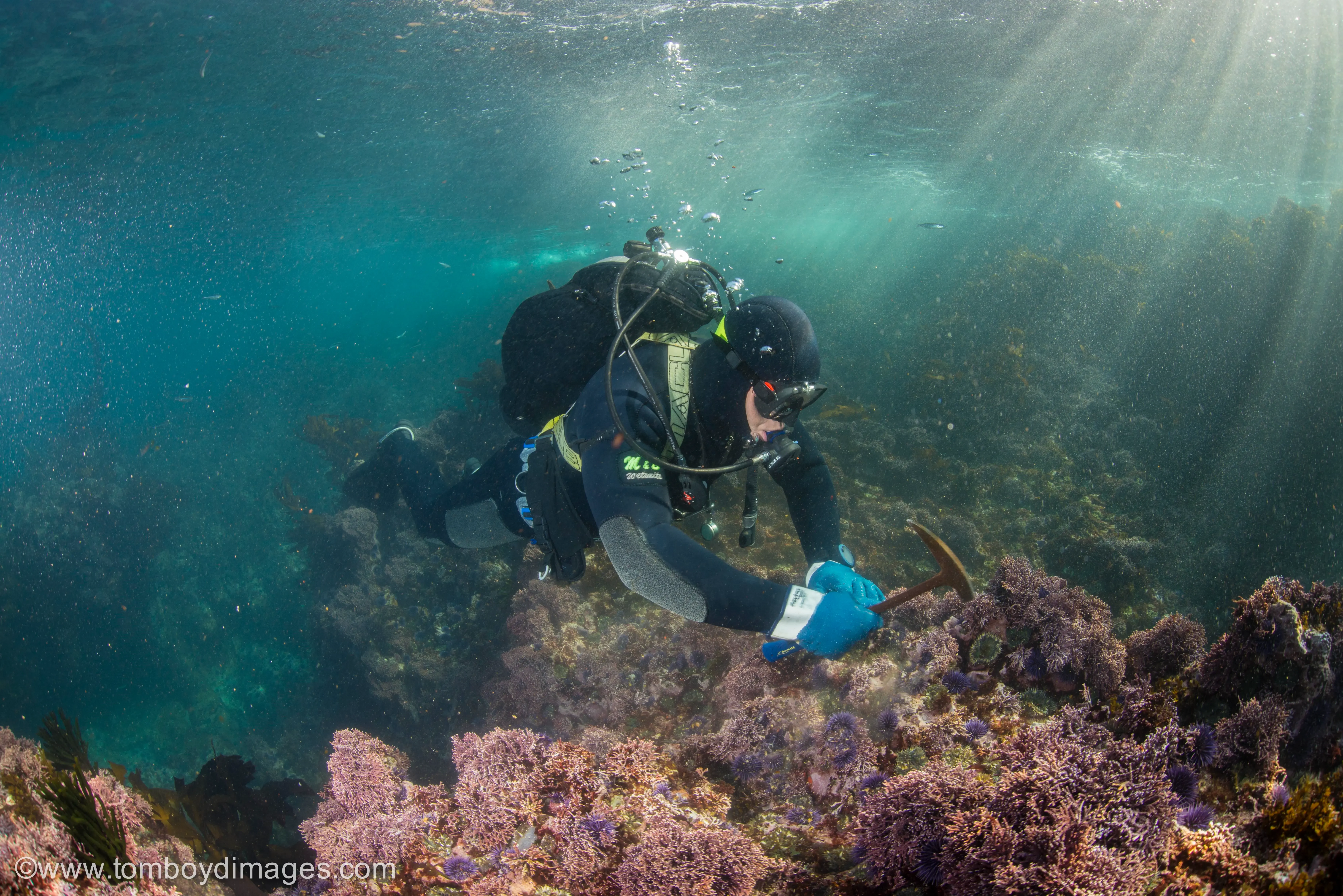
Figure 5.4 Commercial diver removing long-spined sea urchins from productive Ecklonia radiata (golden kelp) and Phyllospora comosa (crayweed) beds in Fortescue Bay, south-eastern Tasmania. Credit: Matt Testoni.
5.8 Gwaii Haanas: Collaborative and culturally connected restoration
Lynn Lee, Daniel McNeill, Vanessa Bellis
Haida Gwaii, an archipelago off northern British Columbia, is the traditional territory of the Haida Nation and home to kelp forests, sea urchins, abalone, and other interconnected species. The ecological loss of sea otters during the maritime fur trade disrupted these relationships, contributing to high abundances of kelp-grazing sea urchins and long-term reductions in kelp forests. Since then, kelp distribution has fluctuated in response to urchin grazing, ocean conditions, and other environmental pressures.
The Chiix̱uu Tll iinasdll—Nurturing Kelp Forests to Grow project was initiated in 2017 and co-led by the Council of the Haida Nation and Parks Canada Gwaii Haanas. Over five years, we aimed to restore kelp habitat, productivity, and biodiversity along approximately 3 km of coastline within Gwaii Haanas National Park Reserve, National Marine Conservation Area Reserve, and Haida Heritage Site. Equally important were cultural goals: strengthening relationships with traditional foods and bringing knowledge of guuding.naay, or red sea urchin, and kelp ecosystems into Haida Gwaii communities and schools.
Equally important were cultural goals
We brought together collaborators from the Council of the Haida Nation, Parks Canada, Fisheries and Oceans Canada, the Pacific Urchin Harvesters Association and researchers from four universities. After two years of baseline surveys, commercial fishery and Haida Fisheries divers reduced red sea urchin densities by more than 90% through fishing and in situ cracking. No kelp was planted or seeded because natural kelp sources were present and grazing pressure was identified as the main barrier to recovery.
Bull kelp canopy area and depth increased rapidly following urchin removal, although kelp abundance and understorey diversity fluctuated in later years, likely in response to renewed grazing and increased ocean temperatures. Annual maintenance and monitoring continued after the initial funding ended in 2022, supported by strong partnerships and shared stewardship goals. Urchins removed during site maintenance and an associated commercial fishery have continued to provide Haida traditional food for local communities, and the commercial fishery contributes an economic dimension to the restoration effort.
The project shows that restoration can deliver ecological, cultural, and social benefits simultaneously when it is grounded in Indigenous governance and long-term relationships. Its central lesson is that sustained recovery depends not only on reducing grazing pressure, but on cooperative management, continued restoration maintenance and monitoring, local food systems, and the values of the people responsible for caring for the place.