
View Metrics

People living within 50km of kelp forests:
2,844,800GDP(B) within 50KM of Kelp:
$87.04 billionOcean Warming Rate by 2100 (°C):
1.925 °CKM2 of Kelp:
3,744Key Species:

Macrocystis pyrifera
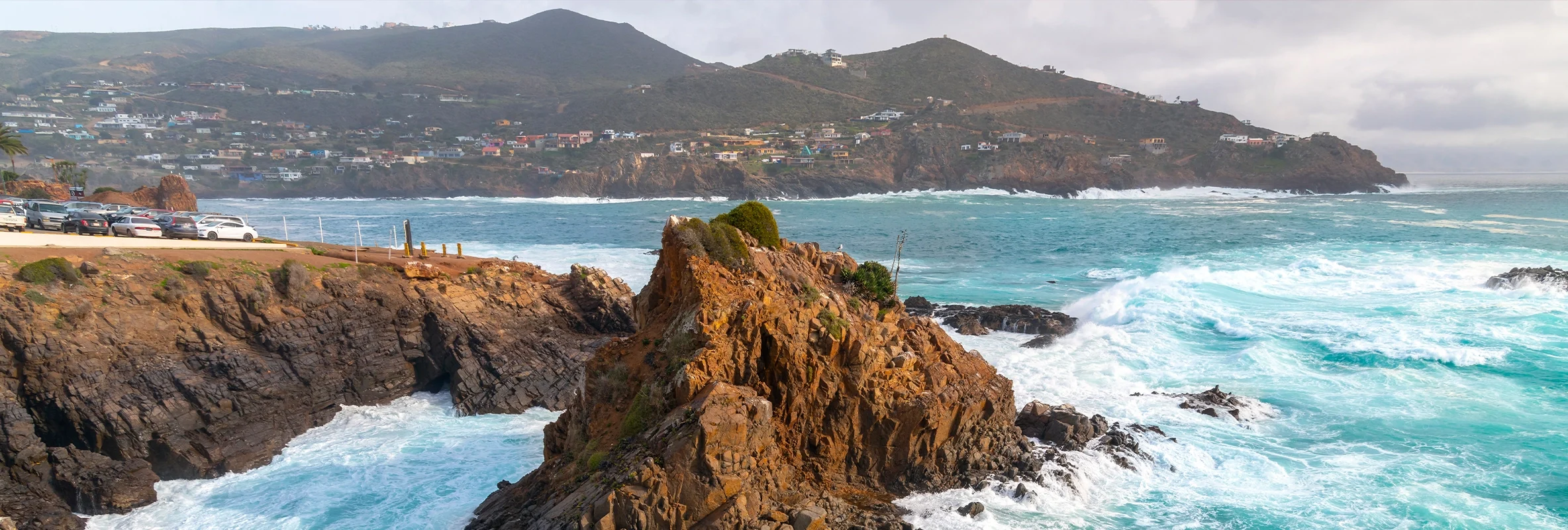
In Mexico, the historic collapse of giant kelp (Macrocystis pyrifera) forests along the Baja California Peninsula between 2014 and 2016 led to a 50% decline in kelp extent by 2023 (Arafeh-Dalmau et al. 2019). This decline has prompted multiple initiatives to protect and restore kelp ecosystems through adaptive, participatory action. In 2022, a fisher coalition, “El Frente,” developed a protection and restoration programme in collaboration with the state fisheries department (SEPESCA) and the local university (Universidad Autónoma de Baja California, UABC). This programme is now included in Mexico’s National Environmental Restoration Plan (PNRA SEMARNAT 2025–2030). The project’s first line of action focuses on protecting persistent kelp forests by removing purple sea urchins (Strongylocentrotus purpuratus). The second line evaluates small-scale restoration techniques, including transplantation of wild juveniles, laboratory-based reproduction of giant kelp using local breeders, and field trials comparing green gravel (Dawkins et al. 2024) and longline methods (Zertuche-Gonzalez et al. 2022). Positive early results have increased fishers’ interest in scaling up efforts, adjusting fisheries management, and considering aquaculture as a pathway that can support both conservation and livelihoods. The third line advances research through field monitoring and the maintenance of a gametophyte bank for Mexican kelp populations, in collaboration with UABC. At UABC, assisted adaptation techniques—such as induction of memory stress and intraspecific hybridization—are also being tested to enhance kelp strains’ resistance to environmental stressors, including ocean warming. In parallel, community-based MPAs, known locally as fishing refuges, are expanding across the Baja California Peninsula (The Nature Conservancy Geoportal). Over the past two years, remote sensing and local ecological knowledge have been combined to identify climate refugia for kelp forests (Lenfest Ocean Program). This work builds on a long-term participatory science programme involving the Federation of Fishing Cooperatives of Baja California (FEDECOOP), NGOs, academia, and state agencies, including the establishment and monitoring of marine reserves led by fishing cooperatives (Micheli et al. 2024). This collaboration has produced a climate adaptation guide with 19 management guidelines, including targeted strategies such as temporary fishing bans on key predator species (Arafeh-Dalmau et al. 2025). Two fishing communities have established, or are in the process of establishing, multiple MPAs to protect persistent kelp forests. Other fishing communities are using the guide to restore persistent kelp forests within their fishing concessions. Monitoring and technology to support conservation and restoration efforts continue to advance. Participatory and science-based kelp monitoring programmes include scuba-based visual surveys assessing fish, invertebrates, algae, and substrate. The first programme launched in 2006 with fishing communities, Comunidad y Biodiversidad, A.C. (COBI), Hopkins Marine Station (Stanford University), and FEDECOOP; it was expanded by UABC in 2011 and continued with the University of Queensland from 2019, when UCLA’s remote sensing was added. Since 2022, the MasKelp initiative (maskelp.info) has co-led an integrated programme with these partners, monitoring 35 sites along the Baja California Peninsula using visual censuses, satellite imagery, and environmental DNA. These efforts are now expanding to other Latin American countries, including Peru, Chile, and Argentina (Stanford Doerr Accelerator Project). Since 2016, the MexCal research group (Management of Ecosystems across the Californias; sites.google.com/uabc.edu.mx/mexcal), based at UABC, has conducted ongoing underwater visual censuses and oceanographic monitoring at 20 sites along the Baja California Peninsula. MexCal has also established a scientific diving training programme to teach students, government personnel, and local fishers (~30 since 2022) how to conduct underwater visual censuses of local fishing resources. In addition, in 2023 MexCal, Reef Check, and ECOCIMATI A.C. launched a citizen science programme that strengthens existing monitoring in Baja California. Through this initiative, the Reef Check Baja California programme trained approximately 20 local divers in 2024–2025, including university students, fishers, NGO practitioners, government staff, and recreational divers from local dive centres.
Mexico’s PNRA 2025–2030 identifies Baja California’s kelp forests as a priority ecosystem for restoration over the coming decades. This creates a unique opportunity to develop a multi-year national kelp restoration and management plan with clear protection and restoration targets. Such plans could build on existing collaborations and international cooperation with Canada, the USA, Peru, Chile, and Argentina. Future restoration and protection efforts are likely to benefit from growing interest among NGOs, funding agencies, scuba divers, and citizen scientists. These efforts can be guided by research on climate refugia, genetic diversity, restoration methods, and the structure and function of persistent kelp ecosystems. Protecting and recovering sea urchin predators through marine reserves and fisheries regulation remains a key strategy for supporting kelp resilience in the Southern California Current (Kumagai et al. 2024). Exploring circular economy pathways—such as markets for sea urchin shells in bioplastics, agriculture, aquaculture feed, or chemical products like magnesium—could also help accelerate herbivore control. Local leadership and environmental education are expanding, particularly for younger generations in Baja’s fishing communities (e.g., COBI’s Agents of Change initiative and outreach led by women diver groups).