
Despite their expansive presence across the world’s coastlines and their ecological, cultural, and economic importance, kelp forests remain underrepresented in conservation policy and funding relative to other coastal ecosystems. In response, the Kelp Forest Challenge was launched in 2023, setting ambitious global targets to protect three million hectares and restore one million hectares of kelp forests by 2040 and to align with international area-based targets for invaluable habitats.
Here, we present a global and regional assessment of the status and future of kelp forest conservation in 30 regions around the world. These insights are drawn from surveys and workshops with 215 participants from 28 countries. Participants, spanning Indigenous and local communities, NGOs, government agencies, academia, and industry, identified key recent developments, threats, opportunities, and strategies that have accelerated action in their regions. Our synthesis reveals that kelp forest management and conservation are a global endeavour that intersects with a diverse range of people and organisations.
Participants identified fisheries provisioning as the top ecosystem service from kelp forests, with some regional variation. Ocean warming was cited as the greatest threat, though regional exceptions were noted. This global assessment establishes a foundation for future updates, regional report cards, and standardised global monitoring. By elevating local knowledge within a coordinated international framework, it provides a pathway to scale kelp protection and restoration while aligning with global biodiversity and climate commitments.
Introduction
Kelp forests, of the orders Laminariales, Fucales, Tilopteridales, and Desmarestiales (Eger et al., 2024a), are dynamic ecosystems that occur across one-third of the world’s coastlines, often dominating temperate and subpolar rocky reefs (Jayathilake and Costello, 2021). These coastal ecosystems are foundational to human experiences across continents (Lee et al., 2021; Teagle et al., 2017; Thurstan et al., 2018), support high biodiversity from epifauna to megafauna (Smale et al., 2013; Steneck et al., 2002), and shape the biophysical characteristics of the ocean (Castorani et al., 2018; Lamy et al., 2020). As a result, they are foundational to ecosystem functioning and human wellbeing across their distribution. Documented declines in kelp forests date back ~100-150 years (Berry et al., 2021; Selgrath et al., 2024; Wilson and North, 1983) but have accelerated in recent decades (Cavanaugh et al., 2019; Mieszkowska and Sugden, 2016; Wernberg et al., 2024). Warming oceans, marine heatwaves, invasive species, overgrazing, coastal development, overharvesting of kelp and predatory species, poor water quality, and pollution all negatively impact kelp forests (Krumhansl et al., 2016; United Nations Environment Programme, 2023), with some regions nearly losing entire populations (Butler et al., 2020; Christie et al., 2019; Rogers-Bennett and Catton, 2019).
Despite their importance and the threats they face, kelp forests have largely been absent from international and national conservation policies (Techera et al., 2024; Valckenaere et al., 2023), resulting in fragmented management, funding, and low public awareness (United Nations Environment Programme, 2023; Vergés et al., 2020a). Recent global conservation initiatives, including the Kunming-Montreal Global Biodiversity Framework's "30x30" target, emphasize the importance of protecting and restoring marine ecosystems, yet explicit targets and standards for kelp forests are lacking (Arafeh-Dalmau et al., 2024; Convention on Biological Diversity, 2022).
In response, the Kelp Forest Challenge (Eger et al., 2024a) was launched at the International Seaweed Symposium in Hobart, Australia, in February 2023. This global grassroots initiative aims to restore one million hectares and protect three million hectares of kelp forests, relying on individual programmes to contribute targets toward the collective goal. Protection refers to spatial management strategies that benefit existing kelp forests, restoration refers to interventions or spatial management strategies that aid the recovery of lost populations, and conservation is an umbrella term that includes both types of activities (Eger et al., 2024a). The Challenge acts globally, while drawing from local experiences, and weaves these experiences into a unified global conservation initiative that speaks with one voice.
The initiative outlines a holistic approach to kelp conservation. The Challenge states that protection and restoration must be combined with stressor management, including the need for global-level actions such as mitigating CO2 emissions (Gann et al., 2019; Johnson et al., 2016). Therefore, the Challenge aims to address background stressors while meeting the individual protection and restoration targets, as is often recognized in regional roadmaps (Cebrian et al., 2021; Hamilton et al., 2024; Verbeek et al., 2021).
Achieving global conservation goals requires both high-level international cooperation and locally informed regional strategies. Past global conservation initiatives (e.g., Aichi Targets) were initial efforts that set the baseline for today’s global conservation agenda (Berkes, 2007; Guerrero et al., 2013). The current Global Biodiversity Framework is more connected to local stakeholders, stewards, practitioners, and communities. In addition, to help address previous shortcomings, the Kelp Forest Challenge has adopted a geographically centred, community-minded approach and is working to integrate data and knowledge from local and regional stakeholders into broader global conservation frameworks (Eger et al., 2024c, 2024b, 2022a). Integration will rely on a combination of inclusive, locally based working groups, coordinated communication between existing groups, and international representation through the Kelp Forest Alliance. These ongoing efforts build on existing knowledge while sharing new insights.
Though funding for kelp forest conservation and research lags behind that of other marine ecosystems (Filz et al., 2025; Saunders et al., 2020), there are significant signs of growth (Eger et al., 2024c; Filbee‐Dexter et al., 2022; United Nations Environment Programme, 2023). The number of known kelp restoration projects per decade nearly doubled between 1998 and 2019 (Eger et al., 2022b). The number of peer-reviewed papers on “kelp forest conservation” also rose, going from 123 between 2015–2019 to 218 between 2020–2024 (Web of Science search, 15/07/2025). The growing number of research projects and scientific publications is continuously expanding the evidence base, which may evolve rapidly as new data become available. Systematic and periodic assessments of emerging findings and future research directions are, therefore, crucial to ensure an up-to-date and comprehensive understanding of the field.
To remain relevant, information on the state of kelp forests must be up-to-date, locally grounded, and linked to the relevant jurisdictions. Substantial information is published on kelp population trends (Krumhansl et al., 2016), major threats (Wernberg et al., 2019), key ecosystem services (Bennett et al., 2016; Eger et al., 2023b; Smale et al., 2013; Vasquez et al., 2014), priority actions for conservation (Eger et al., 2023a), and the current state of kelp conservation (Arafeh-Dalmau et al., 2025; Eger et al., 2024c). However, these advances need to be updated when new information becomes available, be tailored to local needs, and include more diverse opinions, needs, and observations. Addressing these gaps will be critical to inform the current and future state of kelp forest conservation at relevant management jurisdictions.
Methods
We gathered information for this work via the “2nd Kelp Forest Summit”, which was split across two meetings. We held the first meeting before the 25th International Seaweed Symposium (ISS) on May 4th, 2025, in Victoria, B.C., Canada, and the second before the 14th International Temperate Reefs Symposium (ITRS) on June 30th, 2025, in Brest, France. We advertised the workshops on the conference websites, through the Kelp Forest Alliance mailing list (n = ~900), and on social media (LinkedIn and Instagram). We ran both workshops in person but also offered a concurrent online version at ISS. Participation was open to individuals from all countries. We invited participants from diverse backgrounds, including scientists, conservation managers, policymakers, Indigenous and local community representatives, and artists involved in kelp forest conservation.
We invited participants to complete an online survey prior to attending the workshop to assess the current perceptions around kelp forests in specific regions (Appendix 2). We also allowed participants to invite a limited number of additional participants to help fill key sectoral or geographic gaps.
We invited all survey participants as co-authors of this paper, and invitations were based on their expertise and direct involvement in kelp forest conservation. As such, the perspectives presented here are grounded in the professional experiences of researchers, practitioners, and policymakers actively engaged in kelp forest management and restoration. We worked to include a diverse range of voices with global coverage and perspective. Still, we acknowledge that there are many voices in global kelp conservation and that other perspectives may exist beyond those represented by the author team.
Composition of the Participants
Two hundred and fifteen people (215) from 28 countries engaged in the workshops and surveys (Figure 1).
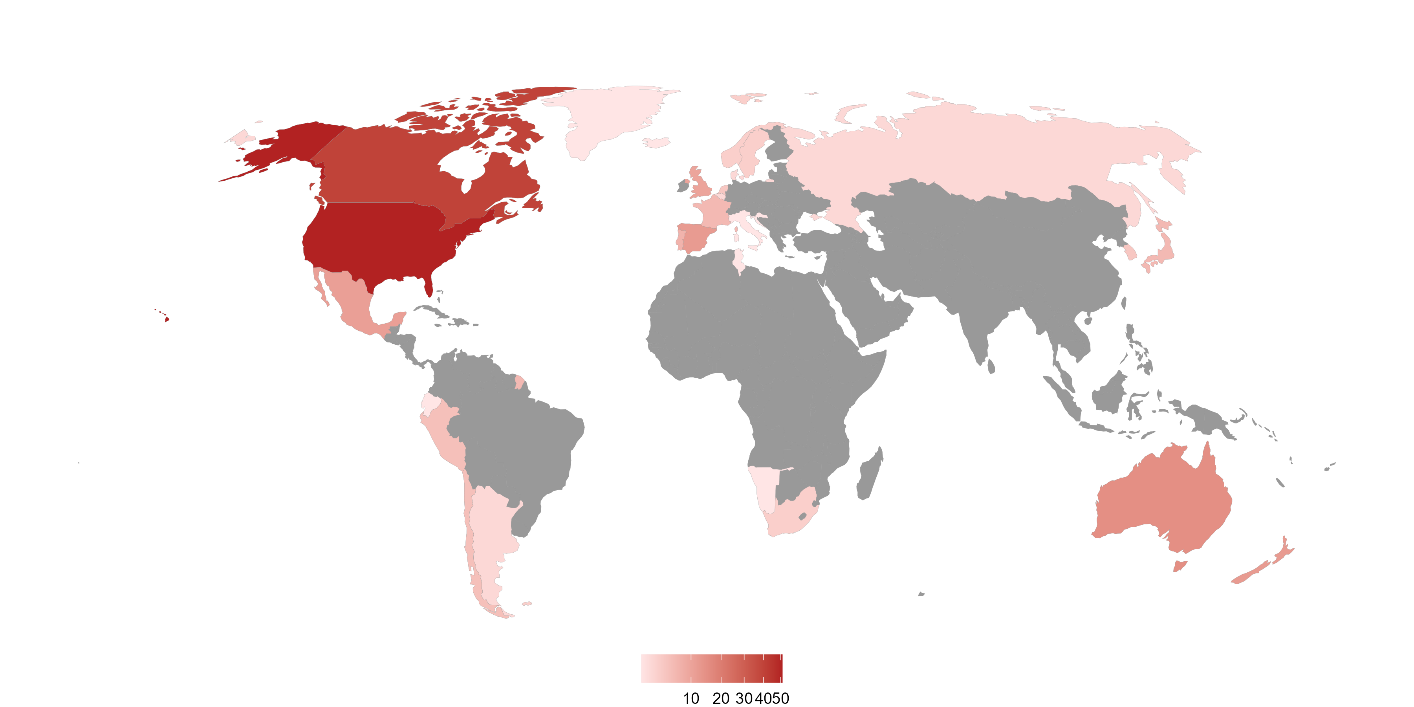
Figure 1: Map of the country origins of the survey participants, shaded by the number of participants from each country. Darker shades indicate more participants, lighter shades indicate fewer, and grey indicates no participants.
Participants had a diversity of backgrounds, with the vast majority holding positions at universities (35%), NGOs (15%), research institutes (13%), or businesses (12%), with 25% connected to government agencies, community groups, the arts, or holding no affiliation (Figure 2). Of these participants, 53% completed the pre-workshop survey. The de-identified details of the participants are provided in Appendix 1.
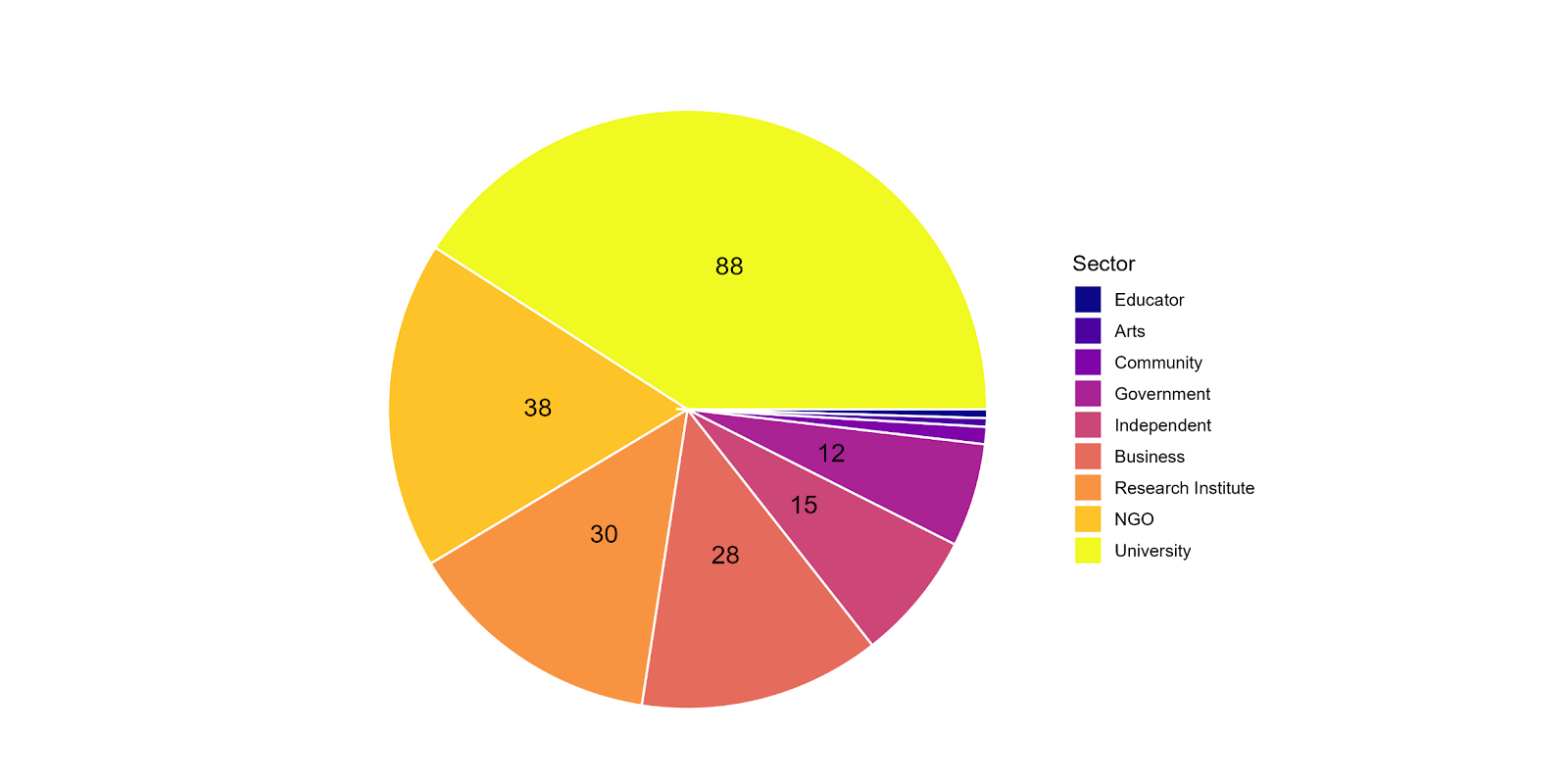
Figure 2: Primary sector for the workshop and survey participants.
Participants were divided into region-specific groups during the workshop and guided through a series of questions (Appendix 2). The questions aimed to identify the current state of kelp conservation, find opportunities for collaboration, and provide a knowledge base to create regional working groups to collect and share information on kelp conservation. Here we provide a summary of participant responses and insights for four key topics:
- Key conservation developments
- Key opportunities for advancing kelp conservation
- What has worked to accelerate conservation
- One useful message
Survey Development and Distribution
The survey was designed to stimulate pre-workshop reflection and assess the priorities identified in the global roadmap generated from the previous Kelp Forest Summit (Eger et al., 2023a).
The survey questions were a mix of ‘open-ended’, ‘select all that apply’, and ‘ranked responses’. This paper presents the results from the questions related to key stressors and key ecosystem services. We did not include the other responses, as to simplify the information presented and discussed. We used a combination of ‘ranked’ and ‘select applicable’ questions to present these results. First, we used the ‘select applicable’ responses to remove categories that had low consensus within regions. We attempted to achieve consensus by keeping responses selected by a large majority (>66% selection by respondents) and we marked those below the threshold as not present in that region. We then scored the ranked responses and normalised them per region, so all scores summed to one. We presented these results based on their cumulative ranking across each region. We coded responses ordinally, so the highest priority response was scored as one point higher than the second priority response and so forth. Finally, we calculated a global score but weighted each region equally to not skew the scores by over- or under-representation from certain geographies.
Regions
The study strived to cover the breadth of countries with kelp forest populations and present the information at the jurisdiction that was relevant for conservation. We therefore divided responses into the 30 regions. We acknowledge the participation numbers are unequal due to the geographic biases based on the meeting locations as well as accessibility and equity issues related to attending international conferences.