
View Metrics


People living within 50km of kelp forests:
19,621,508GDP(B) within 50KM of Kelp:
$976.41 billionOcean Warming Rate by 2100 (°C):
2.2 °CKM2 of Kelp:
90,858Key Species:

Ecklonia radiata

Macrocystis pyrifera
Australia has advanced kelp conservation and restoration over the past three years through a mix of federal, state, and community-led initiatives. A major milestone was the designation of Tasmanian giant kelp forests as a “priority place” under the federal Threatened Species Action Plan (Department of Climate Change, the Environment and Water 2022). This listing signals national recognition and has supported substantial federal funding for coordinated actions including sea urchin management, giant kelp restoration, capacity building, and research.
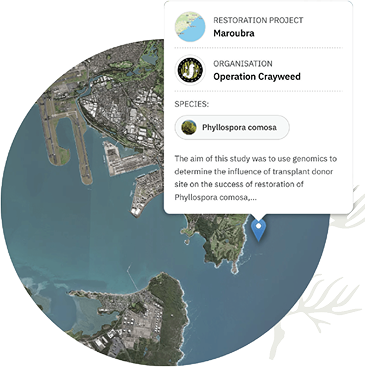
Locally led restoration research has also scaled up. Examples include Operation Crayweed (now restoring at more than 11 sites) in New South Wales, reversing local extinction of the fucoid Phyllospora comosa in Sydney (Vergés et al. 2020a), and restoration of golden kelp (Ecklonia radiata) in Port Phillip Bay (Victoria), where 24 hectares of reef habitat have been improved through urchin culling and kelp restoration. Multi-species trials in South Australia (McLeod et al. 2025) and widespread green gravel trials further reflect the diversity of approaches being explored (Wood et al. 2024a).
Community participation is increasing, including urchin culling led by Friends of Beware Reef (Victoria) and recreational diver training in Tasmania, where 40+ individuals have completed a kelp restoration certification in partnership with local dive operators. Policy developments include consultations to update conservation listings and the establishment of the South Coast Marine Park along Western Australia’s south coast. Collectively, these developments indicate a broader national shift toward recognising kelp forests as essential ecological and cultural assets.
Australia is well positioned to scale kelp conservation through emerging cross-sector approaches that bridge science, community action, cultural knowledge, and policy reform. The Nature Repair Market, while still new, creates a potential pathway for approved kelp restoration methodologies (Carnell et al. 2025), including urchin removal to facilitate kelp recovery.
Policy momentum around urchin management is also building. A Senate inquiry recommended AUD 55 million to manage the range-extending urchin Centrostephanus rodgersii. Aboriginal groups in Sydney, South Coast NSW, and Tasmania are increasingly involved and interested in urchin removal as Sea Country care. For example, the Saving Native Species Programme is training Aboriginal divers to occupational diving standards to increase participation and leadership in kelp conservation.
Several evolving policy frameworks may further shape national direction, including the forthcoming National Marine Science Plan and Australia’s Sustainable Ocean Plan. Philanthropy and alignment with nature-positive markets (biodiversity, carbon, and nature repair credits) also present potential financing pathways. Management tools led by university–government partnerships (e.g., Reef Adapt platform) are supporting climate-smart restoration design and provenance decision-making (Wood et al. 2024b), reflecting a broader shift toward proactive adaptation. National coordination efforts—such as the Great Southern Reef Research Partnership, Parliamentary Friends of the Great Southern Reef, and efforts toward IUCN Red List recognition for kelp species—signal a strategic pivot toward national collaboration and international alignment.
Australia’s progress has been enabled by a combination of grassroots engagement, industry participation, and government support. Public engagement has grown via media, community events, arts-led storytelling, and education (Vergés et al. 2020b). The Great Southern Reef Foundation’s communication strategy—spanning schools, media, and public campaigns—has helped translate ecological complexity into accessible narratives. At the same time, industry and management agencies recognise kelp’s economic value, including its role in supporting key fisheries such as lobster and abalone. An emerging seaweed aquaculture industry may also support restoration by sharing hatcheries and workforces. Economic framing has often proven effective in mobilising political attention and building viable conservation pathways.